Lucas Pereyra
La uruguayaLucas Pereyra’s journey to Montevideo begins as a practical attempt to recover money and ends as a test of how he can narrate what happened to him. A writer stalled by financial pressure, he imagines the advances in his pocket as nearly a year of reclaimed time; at the same time, he has turned Montevideo into the imagined home of Magalí Guerra Zabala, the woman he loves. The city, the money, and the romance briefly seem to open a way out of his life’s impasses, before an assault leaves him injured, robbed, and already revising the account he will give at home.
Identity and Circumstances
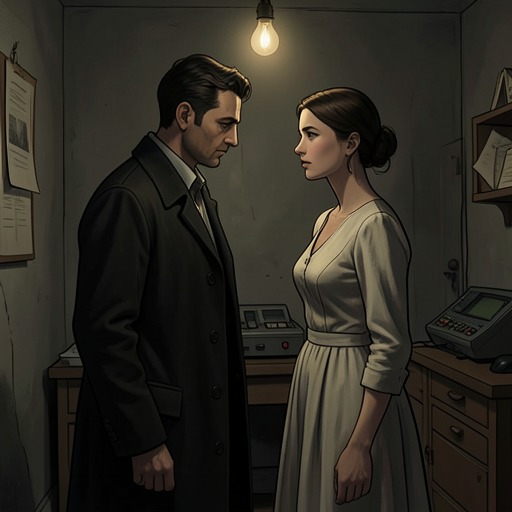
Lucas is a husband and father living under sustained financial strain. One remembered morning begins with the alarm at six and Maiko asleep in the couple’s bed. Lucas’s wife offers to make coffee; he refuses and tells her and Maiko to keep sleeping. The exchange is intimate but muted, conducted in whispers so as not to wake the child and, Lucas suspects, to avoid facing each other with the stale breath of the night. The scene establishes a domestic tenderness shadowed by fatigue and distance.
His writing income has failed to arrive when the household needs it. Lucas recalls that he and his wife had been living on her salary while he went months without work, and he owes her money. His inability to act has spread beyond finances: in his own account, lack of money becomes the repeated explanation for not going out, sending a letter, printing a form, asking an agency for help, fixing dampness, repainting chairs, or sending a résumé. The list makes money more than a practical problem; it has become the refrain organizing his depression and confinement.
Montevideo as Projection and Place
Lucas travels to Uruguay in September to collect advances for books contracted with publishers in Spain and Colombia. He had opened a bank account in Montevideo in April, but the payments only become available months later. If transferred to Argentina, the dollars would be converted at the official exchange rate and reduced by income tax; collecting them in Uruguay and carrying them back as cash could leave him with more than twice as much after exchanging them in Buenos Aires. He knows that carrying more dollars than permitted risks discovery at customs, but considers the journey worthwhile.
On leaving the terminal, he tries to orient himself through Avenida 18 de Julio, which serves as the spine of his limited mental map: the route toward Ciudad Vieja, the banks, La Pasiva, the music shops, and the neighborhoods he associates with remembered visits. Yet the city he walks through is also assembled from Magalí Guerra Zabala’s emails, videos, and songs. A video of musicians performing Te abracé en la noche has become part of his private image of Montevideo; he has watched it repeatedly at home without his wife knowing how deeply it affects him. He admits that he is in love both with a woman who lives there and with the city he has made around her, and that much of this city is invented. His actual walk therefore moves through two places at once: streets underfoot and an emotional geography built from mediated fragments.
The gap between projection and physical detail gives his walk its particular texture. Lucas notices aging shopfronts, subdued displays, and a pastry shop whose elaborate cakes look to him like hardened plaster or ceramic. He also recognizes an allusion to Tiranos temblad when a boy calls out one of the program’s familiar phrases to a friend. The recognition briefly makes him feel included in the city’s web of references. But his attention can turn private signs into messages addressed to him: a flyer advertising tattoos and genital piercings makes him think of Magalí Guerra Zabala’s piercing and the questions he has never asked her. He pockets the flyer, partly struck by its shifting use of formal and informal address. In Lucas’s account, the lovesick mind reads street advertisements, songs, and passing details as personal signals.
Money, Time, and Desire
At the bank, Lucas exchanges the dollars and hides the cash in the inner pocket of his jacket, while putting the pesos in his trousers. Leaving without looking anyone in the eye, he feels the bundle against his chest as a sudden opening in every direction. The money means that time belongs to him again: he imagines being able to write exclusively for about ten months, provided he spends carefully. Magalí Guerra Zabala is his first thought as he experiences that possibility. Hope does not cancel fear, however; he feels like prey and hurries through Plaza del Entrevero, crossing the avenue mid-block before entering La Pasiva.
The sum also carries the weight of the household that made the trip necessary. Lucas intends to repay the pesos his wife lent him during his months without work. His memory of their earlier poverty is concrete: on a drive to visit his brother near Pilar, they paid a toll with stacks of fifty-cent coins, fifteen pesos in all, while a line of cars sounded their horns behind them. The attendant initially said fifty centavos were missing, and Lucas insisted she count again. The couple drove off laughing, though he remembers an unspoken bitterness beneath the laughter. The recovered advances promise not simply spending power but relief from a humiliation and a shared dependence that he has never fully resolved.
Desire and the City Encounter
With the cash secured, Lucas relaxes into the day and walks toward his meeting with Magalí Guerra Zabala. At Plaza Independencia, a pair of Brazilian tourists look up toward Palacio Salvo. Their gesture triggers Lucas’s recollection of an album cover she had sent him, which showed the building from a high angle. He connects that viewpoint to the Radisson Montevideo Victoria Plaza Hotel and enters the hotel, following an association from the street into a space of polished marble, leather chairs, and international luxury. The episode shows how his desire converts urban observation into a chain of permissions: a building recalls an image, the image suggests a vantage point, and the vantage point becomes an action.
Later, while walking with Magalí Guerra Zabala through Cordón, Lucas recognizes the University of the Republic and thinks of its image on the five-hundred-peso note. The city keeps collapsing into other forms of representation: banknote, song, video, literary scene. Near the descent toward the rambla, he recalls a powerful scene by Onetti involving a woman in a white dress being made to walk down the street while a man watches from the waterfront. He shares the literary association with her as they walk. Montevideo is not merely the setting for their meeting; it is the material through which Lucas keeps trying to make his feelings legible, even as the real city resists the completeness of his imagined one.
Assault and the Story He Tells
At the beach, Lucas and Magalí Guerra Zabala are together when two men attack from behind him. One forces his face into the sand and presses his weight onto Lucas’s back. Lucas is kicked in the ribs and then the stomach when he tries to rise after hearing Magalí Guerra Zabala being shaken. In the moment, he is more ashamed of having his trousers undone and his penis exposed than afraid of dying. The attackers run; Lucas struggles to breathe, spits out sand, and checks that she is unharmed. His belt and the money are gone, as is his backpack.
The robbery destroys the practical future that the cash had seemed to guarantee. Lucas anticipates replacing his Visa card, identity document, health-insurance card, transit card, and driving licence. He is left with pain in his side and sand in his pockets. On the ferry, he finds a caramel from that afternoon and notices the name Zabala on the wrapper, linking it to Magalí Guerra Zabala’s surname and to Bruno Mauricio de Zabala, identified through Wikipedia as Montevideo’s founder. Even in the aftermath, chance details enter his associative thinking, but they cannot restore what he has lost.
Lucas’s immediate problem is not only how to explain the theft but how to explain the circumstances that brought him there. He imagines telling his wife that he was robbed while walking to the car after returning to Buenos Aires: the robbery, violence, humiliation, and desperation would remain true, while the location and time would be false. He compares this altered account to Borges’s story Emma Zunz, in which the circumstances can be fabricated while essential facts remain real. The version he rehearses is more credible to him and easier to understand than the actual chain of events. It is also an attempt to protect himself from the judgment implied by the trip: his wife had been supporting him for nearly a year and had bought his passage, and he returns with no money, a tattoo on his shoulder, and a ukulele.
The book left about the journey’s conclusion remains behind at the hotel: Lucas’s biography of Rimbaud is on the bedside table, and he wonders whether Enzo Arredondo could retrieve it. As the ferry begins to move, he lies across several seats, his side still hurting, and thinks of Rimbaud returning sick, exhausted, unsuccessful, and robbed after trying to sell arms in Africa. That literary parallel does not undo Lucas’s injury or replace the stolen money. It gives him another frame through which to understand failure, while his planned false account shows how urgently he needs to decide what version of the day can be lived with and told.